• My old friend Flavio Garcia died yesterday.

    I met him at Fort Huachuca, Arizona, when we were both 8-year-old sons of sergeants in third grade at Colonel Johnston School. He was a cheerful student and an excellent athlete, despite having a heart with an enlarged aorta that occasionally made him pass out.

    The summer before our fifth-grade year, Flavio was taken to Letterman Hospital in San Francisco for an operation to correct that heart problem. He came back fully recovered, and he caused a sensation when he took off his shirt on the playground to show off a 68-stitch scar.

    As some of you know, I wrote “Tumbleweed Forts” about living on Fort Huachuca and, as my best friend, Flavio is featured prominently in the book, from the busy classrooms to the wide open desert to the cool mysteries of Huachuca Canyon. He even saved my life when I jumped in a deep lake at St. Davids before I knew how to swim.

    Flavio played baseball in Fort Huachuca and, years after our families parted ways for other Army posts, he played football in high school. Later, he took up tennis and made many more friends in that pastime. Eventually, he got a job as a mailman. He met a wonderful woman, Cindy, and they married and settled down in Huntington Beach, California.

    Last October, Flavio drove out to southern Arizona, and my brother George and I traveled there from our homes in Pennsylvania. We used that little reunion as a chance to look around the old fort again, and to visit Tombstone during Helldorado Days. We had a great time.

    Thank goodness for that get-together. Flavio’s heart was still strong. But in the last few months, the heart troubles returned. He had surgery to implant new stents. He saw a doctor on Friday, and he was scheduled to see another doctor soon to get an internal defibrillator.

    I chatted with him on the phone two nights ago. We talked about the NFL’s Sunday football games — especially his Chargers and my Eagles. He seemed weak, but he was as friendly as ever.

    This morning his heart gave out.

    Flavio Garcia was a good guy. He seemed to enjoy everything he did. As I said in the book, Flavio wouldn’t say “Do this” or “Do that.” He led by action. He seemed to have so much fun doing whatever he did, everyone else wanted to do it too.

    When our fifth-grade music teacher, Mrs. Smith, showed us how to square dance, she taught Flavio first, because she knew that if Flavio figured out that do-si-do, everyone else would try it that much harder.

    Godspeed, my old friend. You brightened so many lives. You showed all of us how to have fun.

    Flavio was 73.

  • The old Tumbleweed Forts book blog is disappearing into history, but all those memories are reappearing immediately here on WordPress. This web page or blog remains dedicated to the countless Army brats who lived in Fort Huachuca, Arizona, at one time or another.

    If you’re the son or daughter of a soldier who was stationed at Fort Huachuca at any time since World War II, check out what this page has to offer and give us an account of your most vivid memories of the old post.

    My three brothers and I lived in Fort Huachuca from 1960 to 1963, when my father, a master sergeant, was testing the Army’s early drones over the fort’s West Range. At Huachuca, we four boys enjoyed the desert, the canyon, the exploring we did, and the friendships we made.

    Many of our stories are in the book, Tumbleweed Forts: Adventures of an Army Brat, and in the Huachuca Books series: “Ride West to Fort Huachuca,” “Water Rescue at the Desert Oasis,” “Huachuca Drones into the Atomic Cloud,” “The New Girl Chases Dust Devils,” and “The Big Dig for Canyon Gold.”

    Frank Warner

  • ARRIVAL AT THE NEW POST, 1960

    Due north of Fort Huachuca, we moved down one last, long road, a highway that cut straight through eight miles of next to nothing. The sky was dark, with a bluish hint of dawn. On the roadside, every mile or so, we saw dark, coiled, ribbon-like figures, maybe three or four feet long. Mom gasped.

    “Is this desert full of snakes?” she asked. “What a place to bring children.”

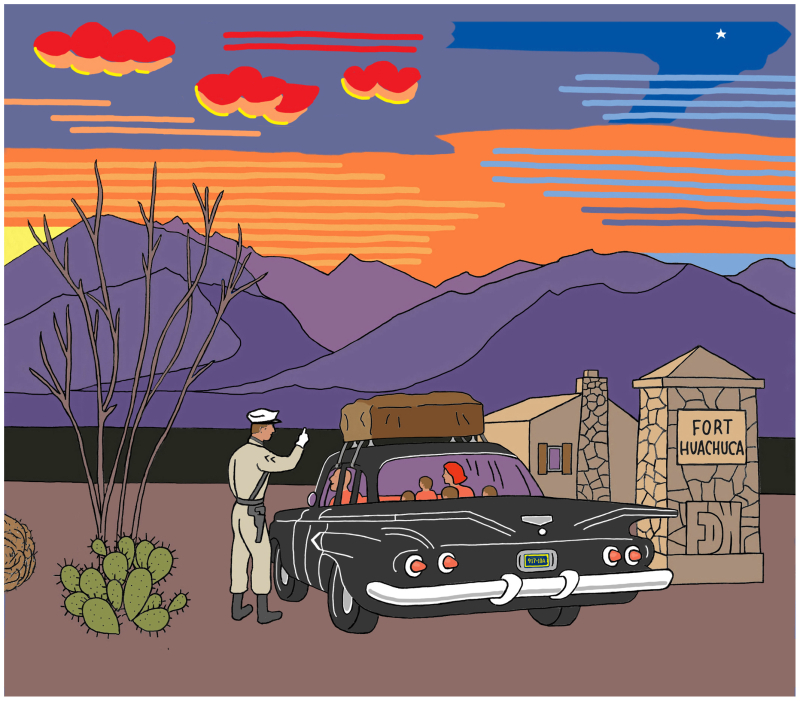
    At dawn, a military policeman – an MP – stopped our car at the fort’s East Gate guardhouse. He was a young man in crisp khaki shirt and pants, white hat, the MP armband, and a cross strap to his holstered pistol.

    “How can I help you?” he asked my father.

    “I’m reporting on orders,” Dad said, handing the MP his Army identification card. “We’re moving in. Can you give me directions to headquarters?”

    “Well, Master Sergeant Warner, that would be Greely Hall. You go a mile and a half down this road, turn right at Irwin, go another mile and turn left on Arizona. Greely Hall is there, on your left. But I don’t think the offices are open yet.”

    “We’ll just take a look,” Dad said. “Thanks!”

    The MP saluted as we left. Soon we were winding our way past soldiers’ barracks and other official buildings. I couldn’t take my eyes off the Huachuca Mountains to the south. As the sun rose, their rounded peaks and mysterious folds were an imposing sight. This was a lot different from our last post in Heidelberg, West Germany.

    Dad tapped the car’s odometer. “Since we left Pennsylvania, we’ve come 2,582 miles,” he said. He drove us past Greely Hall and accidentally wandered onto Grierson Avenue, past the thirteen homes reserved for the fort’s top officers. These were two-story mansions with gabled roofs, screened porches, and lots of chimneys.

    Warners Alhambra car carrier 1961
    Warner family and their '60 Chevy Biscayne, with roof rack


    Once out of the Old Post, we rode east through the fort’s other neighborhoods and out the Main Gate to the neighboring town of Sierra Vista. Here we checked into the El Coronado Motel, a two-story turquoise lodge on Sierra Vista’s main street, Fry Boulevard. The motel room was small but comfortable, with a kitchenette just big enough to make a sandwich.

    Dad showered, shaved, and put on his uniform. He drove back to the fort to report for duty at headquarters for the Army Electronic Proving Ground.  

    Mom walked the rest of us across Fry Boulevard to the post office, where she mailed a handful of letters. Then she led us next door to the offices of the Huachuca Herald, the weekly newspaper. At the front counter, Betty Wolle, the Herald’s receptionist, was folding newspapers and stuffing them with comics.

    When we filed in, she immediately recognized us – most of us. She looked at little George, sitting in a stroller. “Where did he come from?”

    It had been three years since the Warners, Mrs. Wolle, and her husband, Sergeant Bill Wolle, had picnicked together at the New Jersey shore. That day on the beach, the grownups laughed as Carl, Mark, and I shoveled piles of sand into the back seat of our old car. We wanted the beach to come home with us. Dad had to stop us.

    At that time, we Warners and the Wolles were stationed in Fort Monmouth. Dad had known Sergeant Wolle since the early 1950s, when the two of them were Army recruiters in Allentown, Pennsylvania. When my family left Fort Monmouth for France in 1958, the Wolles transferred to Fort Huachuca. Now Sergeant Wolle was away in South Korea for a year, and while he was there, Mrs. Wolle stayed in Arizona.

    She stood up. “Welcome to Sour Vista!” That was the nickname some of the locals had for Sierra Vista. The town had about 3,000 residents and only a few regular houses in what appeared to be a collection of tossed-together neighborhoods.

    Mrs. Wolle took us to her shiny silver mobile home. She lived in the trailer park behind the A.J. Bayless’s supermarket and the El Rancho Roller Rink. Her trailer was made by Spartan, a company that once manufactured airplane fuselages, and it had an aluminum-and-rivets airplane look about it.

    Mobile homes seemed a great idea to me. We were moving all the time, everywhere loading and unloading boxes, beds, bureaus, and that china cabinet. Why not take the whole house?

    “A trailer home makes sense,” Mrs. Wolle said as she led us inside. “Why gamble your money on a real house in Sierra Vista? No one knows if this town has a future.”

    Mrs. Wolle started a burner for coffee on her small stove. She opened her small cabinet for cups, and took a bottle of orange juice from her compact refrigerator. Soon we all had something to drink. As she and Mom chatted, we boys snooped into the trailer’s tiny bedroom and bathroom.

    “Mrs. Wolle must sleep with her knees bent,” Mark whispered.

    “Bent into her chin,” Carl said.

    “The civilians are here for Fort Huachuca’s jobs,” Mrs. Wolle told Mom, “but if the fort goes, the jobs will go, and the people will go too,” she said.

    “But the fort’s not going anywhere, is it?” Mom asked.

    “Hard to tell. The fort already has shut down twice since World War II. The Electronic Proving Ground has been open since ’54, but it could close again whenever the Army decides. For right now, though, the place is hoppin’.”

    Fort Huachuca, about fifteen miles square and stretching south to within seven miles of the Mexican border, now had 10,000 residents. These were the soldiers with their families, sent here for a variety of jobs.

    Mrs. Wolle said the drones were the fort’s biggest new project. Other soldiers were testing new mobile communications equipment. Still others were trying to improve weather forecasting for battle. The fort was busy and getting busier.

    When Dad came back to our motel room that evening, Mom set Mark’s birthday cake on the kitchenette counter. She’d bought it at A.J. Bayless’s.

    George’s eyes followed Dad’s cigarette lighter as it stopped at each candle, and we sang “Happy Birthday.”

    Six candles burned bright.

    “Mark, make a wish,” Carl said.

    “Don’t tell us what it is,” I said.

    Mom cut the cake. “Thank God we all got here safely,” she said.

    “Amen,” said Dad.

    Mark blew out the flames, and after a short party we all fell asleep.

    * * *

    From "Tumbleweed Forts: Adventures of an Army Brat," 2022

  • Flavio Garcia and I walked our bikes up the Smith Avenue hill, past General Myer School on the left. It was mid-June 1961 in Fort Huachuca, Arizona, a perfect sunny day for looking around.

    When we reached Winrow Road, we saw a white-gloved MP holding up regular traffic. Army jeeps, trucks, tanks, and 155mm howitzers – big artillery guns – were moving through the intersection in a convoy headed to the West Range. This was maneuvers week for the National Guard out of Phoenix, and they were testing some big weapons.

    To get around the traffic jam, Flavio and I jumped on our bikes and took a shortcut between Post Chapel No. 1 and Whitside School.

    Biking west on Rhea Avenue, we passed seven old wooden buildings on our right. They had long wooden porches and second-floor balconies. The buildings used to be barracks. The second building was the post library now. The others had become Army offices. They all still looked like barracks to me.

    Flavio and I quickly made our way around the accounting office to Augur Avenue. Here were more old buildings on our right and, to our left, the open parade field. We sped up here on the long straightaway, going west past the old guardhouse and post bakery.

    Nearly halfway down Augur Avenue, I yelled to Flavio, “I’ll race you to the flagpole!”

    I didn’t know why I said that. Of the two of us, Flavio was the real athlete. He was skinny, and so was I, but he was stronger and faster than most boys our age. I knew it and I knew he knew it.

    Both of us stood up on our pedals and revved for speed. The flagpole was on the other side of the parade field. It wasn’t far. To get there, we had two turns and less than 600 yards of street. We accelerated. Flavio zipped ahead, and I tried hard to keep up. My legs already hurt at the first turn, a left onto Adair Avenue, a short street. We were at the southwest end of the parade field. Flavio was two bicycle lengths ahead of me. I told myself I had to get going.

    Flavio looked back. I pedaled harder, and my thighs and calves hurt even more. I kept at it and noticed that, in just sixty or seventy yards, I was closing in on him. At the second left, turning northeast from Adair, he seemed to be sprinting and yet I caught up. I was passing him! This was on Colonels Row. With the parade field still on our left, we hustled past the mansions on our right.

    Two hundred and fifty yards to go, and I was a bicycle length ahead of Flavio. I knew he probably was letting me go ahead, and I knew he probably knew I knew, but I enjoyed first place for the moment.

    With 150 yards to go, I was two bicycle lengths ahead. Then Flavio made his move. He was catching up. I pushed the pedals with all the energy I had, but he was gaining on my right. The flagpole looked within reach now, just ahead and slightly to the left, its stars and stripes fluttering at the southeast edge of the Parade Field. With thirty yards to go, Flavio trailed but was speeding up to me. We both were pedaling like the cartoon Road Runner when we crossed the invisible finish line.

    “A tie!” Flavio yelled.

    Here we were, laughing and exhausted, circling to a stop between the flagpole and General Uhrhane’s house. It was a friendly tie.

    * * *

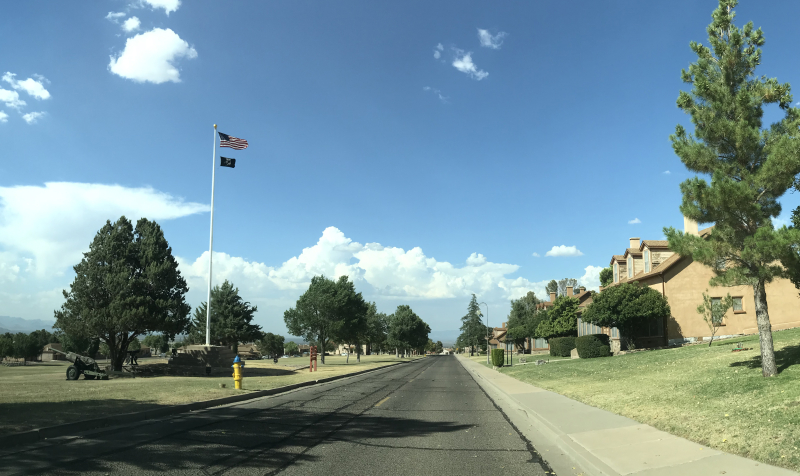
    A Colonels Row June 13 IMG_8666(Photo of Colonels Row from 2022)
  • ('Solder' is pronounced 'sodder.')

    When he was twelve years old, Tom Warner played with his first crystal radio set in Easton, Pennsylvania.

    Then he got serious about electronics. When he was fourteen, he built a Hartley oscillator and connected it to a modulator.

    His six-watt radio signal carried across the Lehigh River to the other side of Easton.

    “That made me a radio broadcaster,” he told us, his four sons. From his bedroom radio station, he played all the popular records of the time – the music of Bing Crosby, the Dorsey brothers, Glenn Miller, and other big bands. Friends and even strangers phoned the Warner house, and he put their requests on the air.

    Decades later, at Warners’ quarters in Fort Huachuca, Arizona, Dad still worked on radios. As a Signal Corps master sergeant in the early 1960s, radio-guided drones were his job. But even at home, he toyed with one electronics project after another.

    With a volt-ohmmeter and a soldering iron at his side, he’d work hours into the night installing tiny components around vacuum tubes on metal frames. His soldering iron looked like an oversize pen at the end of a thick electric cord.

    The solder wire, a mixture of soft lead and tin, rolled off a spool when Dad needed it. Smoke rose as his red-hot iron melted the solder to join capacitors, resistors, and other components to their circuits, and to piece together what seemed like hundreds of little wires.

    I couldn’t imagine how Dad read the complicated instructions and kept track of all those parts, but I could see the intense concentration on his face. It was a quiet, hazy atmosphere.

    To me, the smell of hot solder was the smell of a man thinking.

    * * *

    Tom Warner Black tower Sensor Lab Fort Huachuca 1962


    Photo: Master Sgt. Thomas Warner at the Sensor Lab next to the Black Tower in Fort Huachuca, 1962

  • 19 Warner bros George Mark Frank Carl Christmas 1962

    From 'Tumbleweed Forts: Adventures of an Army Brat'

    On Christmas Eve, while Dad was painting black roads on his new train set, I asked him for another look at the silver dollars he brought back from the Nevada atomic test.

    “I want a closer look," I said. "I might draw a picture of them. You said we could see the silver dollars whenever we wanted.”

    “I did say that,” Dad said. He put down the paintbrush and headed down the hall. I hurried after him. My brothers, who knew what I was up to, followed along to Mom and Dad’s bedroom.

    Dad opened his closet and pushed his hanging uniforms aside, revealing his 30-30 Marlin, his .22 Winchester and, in front of the rifles, his footlocker.

    He opened the footlocker. There was the puzzle box, which he carried to the dining room table.

    “This is the Japanese puzzle box your Uncle Carl sent me from Japan in 1951, not long before he was shot down over Korea,” Dad told my brothers and me. “His C-119 cargo plane was based in Japan.

    “The box is small, but it’s a pretty safe place to keep things. It’s not easy to open. It doesn’t have a lock, and that’s because the whole box is a lock.”

    He turned the box this way and that, shifting the side slats here and there. Then he lifted off the Mount Fuji lid. When he set the box down, we saw the four silver dollars and other mementoes we discovered when Dad was away.

    “Here are your silver dollars,” he said, dropping them in my hand.

    “That box is neat,” I said, still looking inside. “And what is this?”

    I stacked the four coins on the table and pointed to the paper dollar, the real reason I wanted Dad to open the box. I wanted him to tell us about the dollar bill.

    “This dollar?” He took it out and stretched it between his hands. “This is something I carried around Europe the last three years of World War II.”

    Mom sat down with us.

    “Every time my battalion moved to a new location, I’d take the dollar out of my wallet and write down the town’s name,” Dad said.

    “Those towns – Harze, Malmedy, Mulartshutte – when were you there?” Carl asked.

    “That was December 1944 and January of ’45. We were in Belgium and Germany in the Battle of the Bulge. It was the biggest battle fought by the U.S. Army in World War II.”

    “You were in the battle?” I asked.

    “Yep. It was that big.”

    “What happened there?”

    Mom stood up.

    “Maybe we don’t need war stories the night before Christmas,” she said. “It’s bedtime, boys. And Tom, don't you have a little town and a big mountain to finish?”

    “You’re right, Georgiana,” Dad said. “But let me tell our boys about one night of the war. This was a quiet night, but not really too quiet. It was Christmas 1944, about a week into the big battle. Everyone in my battalion was tired and cold. We stopped at a farm in Belgium, near a village called Harze, and the farmer let a bunch of us sleep that night in the hayloft of his stone barn.

    “I was in a sleeping bag, the kind that shut with a long zipper. There were cows on the floor below us. Their body heat helped keep us warm.

    “Late that night, the Germans were shooting V-1s, the buzz bombs, over us. They were trying to knock out our supply depots of ammo and gas in Antwerp and Liege. Each one of these little rockets buzzed over like a drone until the engine shut off. Then it dropped, made no noise for five or ten seconds, and boom, it hit the ground and exploded.

    “It was funny to listen. In the middle of the night, you could hear all these guys in the hayloft snoring away. But when a V-1 engine went quiet, they’d all stop snoring. And when the bomb blew up, we’d all start snoring again like nothing happened.”

    We laughed at Dad’s story. We tried to imagine a chorus of snores interrupted by a bomb, then the snores coming back.

    “After the boom, Dad, you felt safe again because the bomb didn’t hit you,” Mark said. “Is that right?”

    “That’s right.”

    “Did any of the buzz bombs blow up near you?” Mark asked.

    “One came close,” Dad said. “It dropped along the road. The explosion knocked over one of our trucks and a trailer, but nobody got hurt. We were lucky that night.”

    Mark studied Dad’s old dollar bill. He found the name, Harze. That was where Dad slept under the buzz bombs.

    “You know, Dad, sometimes I hear you snore at night,” Mark said.

    “What do you think that means?”

    “No bombs exploding?”

    Dad smiled.

    “Yeah, that might be it.”

    “Now get to bed, boys,” Mom said. “It’s almost Christmas. Thank God for silent nights.”

    As we headed to bed, Dad put the dollar bill back in the puzzle box, and he noticed the four big coins were still on the table.

    “Frank, how about these silver dollars?” he called to me. “Didn’t you want to see them?”

    “I saw them, thanks,” I said. “I’ll take another look some other day. Merry Christmas, Mom! And Merry Christmas, Sergeant Warner!”

    In the morning, Dad’s train set looked like a real town, with houses, shops, lights, and people, and even a church with a steeple. Two locomotives, both puffing smoke, pulled coal cars, freight cars, and passenger cars in and out of the little town.

    The mountain was complete. Overnight, it grew hundreds of trees and shrubs, and its tunnels now had stone-trimmed portals to make the openings look more like real tunnels. Dad’s annual miracle was done.

    I had asked for a small hand-cranked movie projector for Christmas, and I was so happy to get it. Now I could show old eight-millimeter films of Laurel and Hardy, Betty Boop, and Popeye.

    Christmas was one of the few times of the year that Dad joined us for church. Instead of helping us get ready, he put on a civilian suit and walked out the door with us.

    Inside Post Chapel No. 1, I studied the little Nativity scene as Father Lustig told us about the birth of Jesus. I thought, look at all these grownups so happy a baby was born.

    * * *

    In the photo, from left: George, Mark, Frank and Carl Warner. Fort Huachuca, Arizona, Christmas 1962.

  • BLOG BOOK ride 1

    Ride West to Fort Huachuca begins in a burning airplane. It’s late 1960, and after two years in Heidelberg, Germany, Master Sergeant Tom Warner and family are flying back to America.

    The story is told by Frank, one of four sons of the sergeant and Georgiana Warner. The family’s journey is the first episode of the heartwarming and often funny coming-of-age story of a boy discovering the desert, finding new friends and settling into a new home.

    It’s the autobiography of an Army brat, a soldier’s son who already has lived in four Army posts. He must adapt quickly to Fort Huachuca, Arizona, and he must be ready to move again at any time.

    Interwoven into the adventures are reminders of American life in the early 1960s: Elvis Presley’s return from the Army, Eisenhower’s last months as president, Kennedy’s election, TV Westerns, Roger Maris and Mickey Mantle.

    Frank’s father, part of the Signal Corps, has been ordered to Fort Huachuca to experiment with the Army’s flying drones in the desert’s open spaces. An engine fire interrupts the Warners’ plane flight from Germany. Once they reach the States, they take a car out Route 66 to Arizona.

    Within six months, Frank and his brothers change schools four times. Carl, Mark, George, and he are forced to adjust and learn the new rules of unfamiliar classrooms full of unfamiliar faces. Frank soon makes friends with Flavio Garcia and Terry Cook.

    Frank and his brothers explore the desert. They visit nearby Tombstone. They build tumbleweed forts. And when they hear the legend of lost gold in Huachuca Canyon, they hike the canyon and keep their eyes open for treasure.

    Ride West to Fort Huachuca is the first installment of the five-part Huachuca Books series, which adapts episodes from Frank Warner’s 2021 memoir, Tumbleweed Forts: Adventures of an Army Brat.

  • BLOG BOOK splash 2

    In Water Rescue at the Desert Oasis, Frank and his friend Flavio resume the search for gold in Fort Huachuca, Arizona. Both boys are sons of Army sergeants. As they hike into Huachuca Canyon, an Apache acorn-gatherer warns, “Gold makes people crazy.”

    At home, Frank’s brother Mark and neighbor Peter conduct a dazzling electrical experiment that knocks out the house lights. On Halloween night, Frank and his brothers Carl and Mark take their trick-or-treating to dozens of homes in the fort. At a spooky drainage ditch, Frank witnesses the mysterious Ghost of the Post.

    At the Golden Bell community picnic near Tombstone, Frank leaps into a lake and discovers the water is much too deep for him. He can’t swim, but is anyone around to help?

    Water Rescue at the Desert Oasis is the second installment of the five-part Huachuca Books series, which adapts episodes from Frank Warner’s 2021 memoir, Tumbleweed Forts: Adventures of an Army Brat.

  • BLOG BOOK atom 3

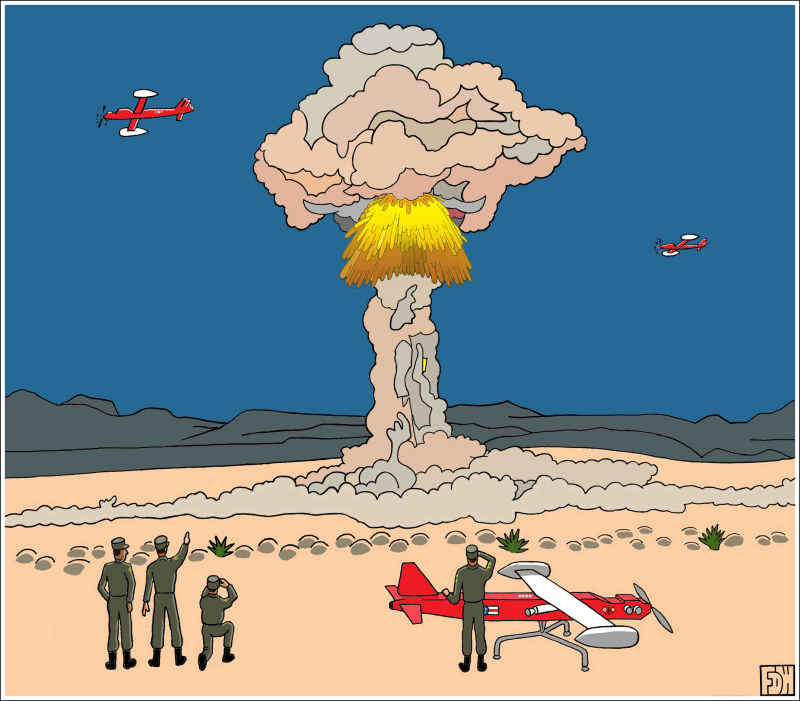
    Huachuca Drones into the Atomic Cloud moves from young Frank Warner’s home in Fort Huachuca, Arizona, to the Nevada Test Site, and back again to the fort in 1962.

    Frank’s father, a master sergeant who is developing drones for the Army, takes a group of Fort Huachuca soldiers to Nevada to fly three drones through the radioactive cloud of an atomic bomb test.

    Back at school in the fort, Frank uses classroom excitement over John Glenn’s Mercury space flight to distract his fourth-grade teacher from grading the homework he has failed to complete. The trick works one day. Soon Frank is in big trouble.

    In winter, Mom’s late-night dishwashing keeps the Warners' water running when all the neighbors’ pipes freeze. Months later, in Little League baseball, Frank steps up to the plate for a chance at final-inning heroics.

    Huachuca Drones is the third installment of the five-part Huachuca Books series, which adapts episodes from Frank Warner’s 2021 memoir, Tumbleweed Forts: Adventures of an Army Brat.

  • HORIZ SIZED dust alt 4

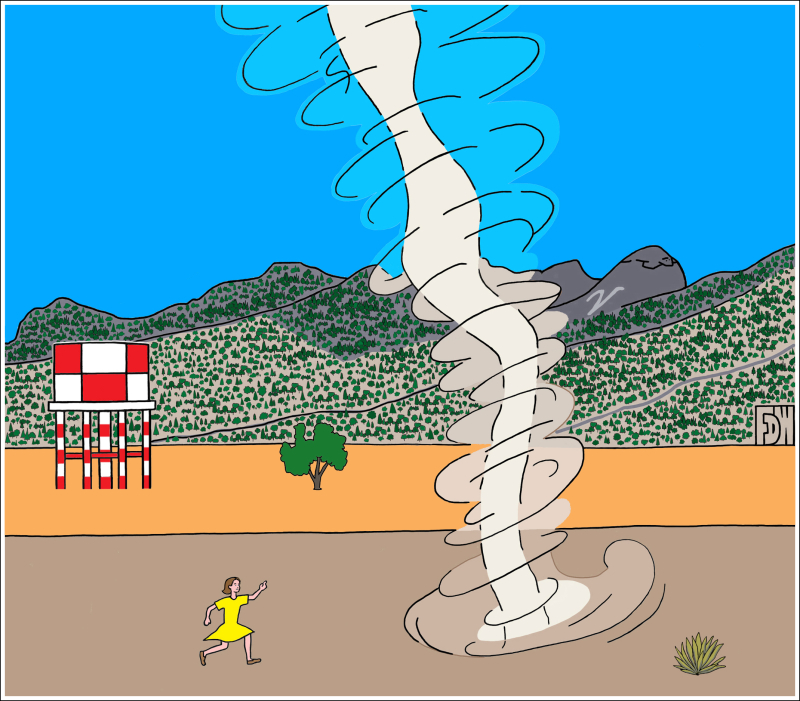
    A new face joins Frank’s circle of fifth-grade friends in Fort Huachuca, Arizona. Emily is the new girl in class. The first time Frank sees her, she’s running after a swirling cloud called a dust devil. As it turns out, Emily dances and spells well too.

    The New Girl Chases Dust Devils also follows other unusual events in Frank’s life. His three-year-old brother George crashes the family car. Frank's best friend Flavio has a heart operation that leaves a big scar. Classmate Diane reveals the pain that prejudice inflicts.

    At Tombstone’s annual Helldorado celebration, Frank and his older brother Carl play trumpets in Mr. Brown’s marching band. They march past the OK Corral before judges decide which band to name best of the parade.

    And in early 1963, just as Frank feels settled into the best place he’s ever lived, the Army orders Frank’s father to go to Vietnam, and the whole family soon may have to leave Fort Huachuca.

    The New Girl Chases Dust Devils is the fourth installment of the five-part Huachuca Books series, which adapts episodes from Frank Warner’s 2021 memoir, Tumbleweed Forts: Adventures of an Army Brat.